By Hassan Adan
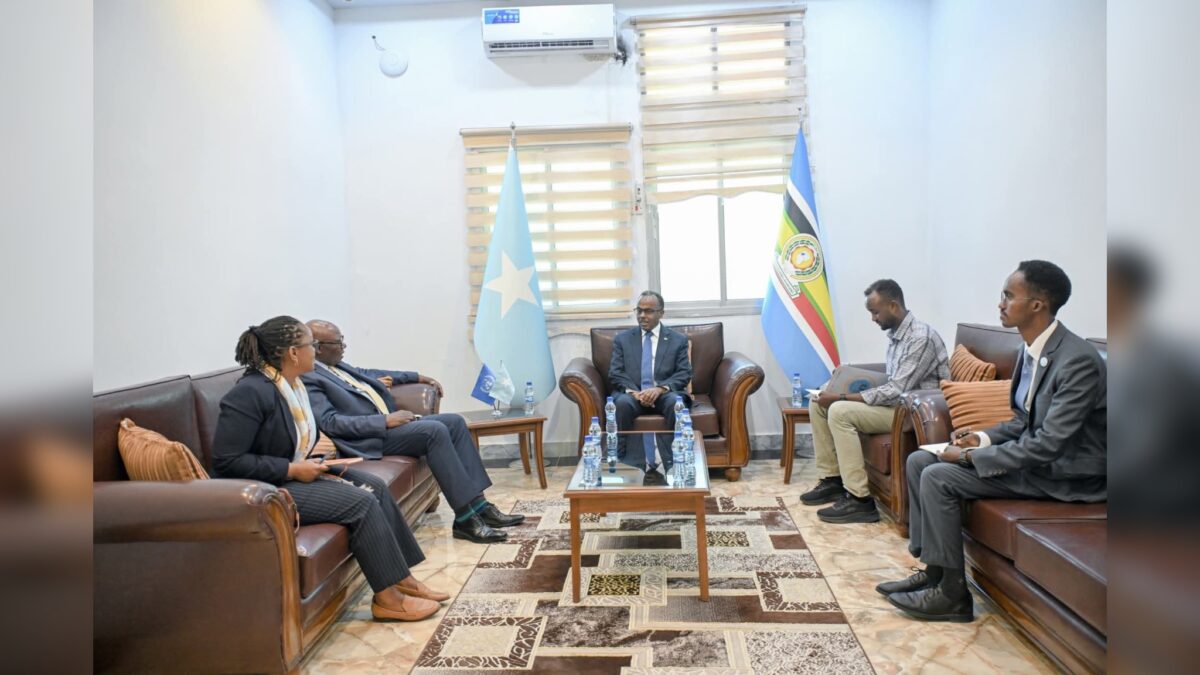
MOGADISHU- Somalia’s State Minister for Foreign Affairs, Ali Mohamed Omar, held talks on Wednesday with Raisedon Zenenga, the officer-in-charge of the United Nations Transition Mission in Somalia, as the government seeks to steer the next phase of its partnership with the United Nations.
Zenenga was accompanied by senior political affairs officer Lebogang Diteko during the meeting in Mogadishu, where both sides focused on the ongoing transition from international-led frameworks toward Somali-owned security and governance structures.
The discussions come at a pivotal moment for Somalia, as authorities in Mogadishu aim to consolidate recent security gains while recalibrating international engagement to align with domestic priorities.
“Our objective is clear — Somalia must lead its own transition,” Ali Mohamed Omar said, according to a statement released after the meeting. “We value the support of the United Nations, but it is essential that this support reflects our national development plans and the aspirations of our people.”
Raisedon Zenenga reaffirmed the United Nations’ commitment to supporting Somalia during the transition period, emphasizing continuity and coordination.
“The United Nations remains a committed partner to Somalia,” he said. “We are working closely with the government to ensure that the transition is smooth, responsible, and aligned with long-term peace building and state-building goals.”
The United Nations has been gradually reconfiguring its presence in Somalia, moving from direct operational roles toward advisory and capacity-building support under the United Nations Transition Mission in Somalia, which replaced the long-standing United Nations Assistance Mission in Somalia framework.
Analysts say the shift reflects growing confidence in Somalia’s federal institutions, although challenges remain, including the threat posed by armed groups and the need for sustained international funding.
The meeting also highlighted efforts to ensure that international assistance is better coordinated and aligned with Somalia’s National Transformation Plan, which prioritizes security sector reform, institutional strengthening, and economic recovery.
Diplomatic activity in Mogadishu has intensified in recent days, underscoring Somalia’s renewed engagement with global partners.
Earlier this week, senior government officials held consultations with regional and international stakeholders on security cooperation and development financing, part of a broader push to position Somalia as a stable partner in the Horn of Africa.
A senior Somali official familiar with the discussions said the government is increasingly asserting ownership over policy direction. “There is a clear shift,” the official said on condition of anonymity. “International partners are still crucial, but Somalia is now setting the agenda — not the other way around.”
The transition process is expected to unfold over the coming months, with benchmarks tied to governance reforms, security responsibilities, and institutional capacity.
Observers say its success will depend on sustained political will in Mogadishu and continued, but recalibrated, international backing