By Hassan Adan
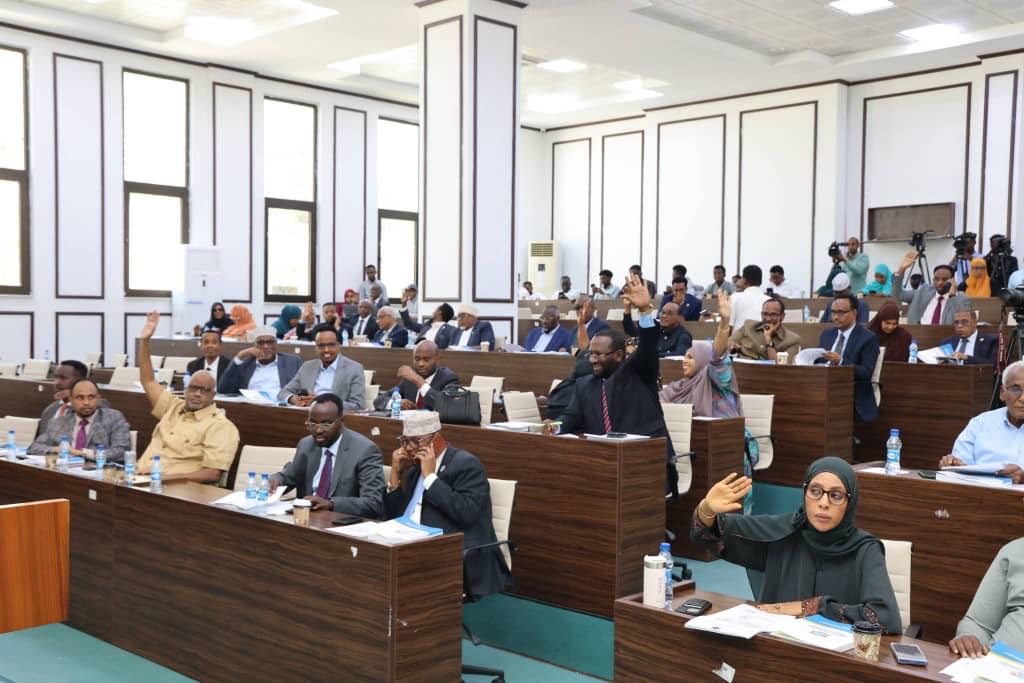
When Somalia’s federal parliament approved the country’s revised constitution earlier this year, government officials presented the moment as nothing short of historic.
After more than a decade under a provisional charter, the leadership in Mogadishu declared that Somalia had entered a new constitutional era—one built on stronger institutions, clearer separation of powers, and the rule of law.
The message from the country’s top leadership was unmistakable: the provisional period was over, the constitution was now fully operational, and Somalia was moving toward a democratic future anchored in institutions rather than personalities.
In one of the most symbolic declarations following the vote, National Assembly Speaker Adan Mohamed Nur Madobe publicly stated that the constitution was now fully functional and no longer provisional.
In another politically significant address, he said the mandate of the current federal government would now expire on May 15, 2027, reflecting the newly adopted constitutional amendment extending federal institutions from four years to five.
At the same time, President Hassan Sheikh Mohamud and Prime Minister Hamza Abdi Barre have been aggressively campaigning on a promise to take Somalia toward one person, one vote—a political project repeatedly presented as the defining democratic legacy of the current administration.
And yet, only months after the revised constitution was passed, the same political leadership now finds itself facing a constitutional contradiction that threatens to overshadow its reform agenda.
Because constitutions are not tested in speeches, ceremonies, or parliamentary celebrations.
They are tested when those in power are asked to obey the very rules they wrote.
That test has now arrived.
In the current revised constitution of Somalia, under Article 81(1)(f), the law states in direct and unmistakable constitutional language:
“A member of the House of the People or the Upper House who is appointed to a ministerial office or any other executive office shall vacate his or her parliamentary seat within the period prescribed by the Constitution.”
For constitutional lawyers, political analysts, and indeed ordinary citizens, the wording is difficult to misread.
The constitution does not use optional language. It does not suggest that lawmakers may step aside, nor does it leave room for political convenience.
It uses one of the strongest legal formulations available in constitutional drafting—“shall vacate.” In legal and political terms, that is not advice, not political preference, and certainly not a matter of negotiation.
It is a constitutional command.
What makes the current controversy even more politically sensitive is that, before the constitution was revised, Somalia’s previous provisional framework allowed elected members of parliament to be appointed as ministers, state ministers, deputy ministers, or other executive officials without surrendering their parliamentary seats. For years, dual office-holding was not only tolerated—it was normal political practice.
But the constitutional amendment was supposed to change that.
That was precisely the point of reform.
And yet, when the revised constitution was passed, several lawmakers from both the House of the People and the Upper House who were already serving in executive positions did not publicly vacate either office. Some remained ministers while still occupying parliamentary seats.
Others continued to serve as assistant ministers or state ministers without any visible constitutional transition.
At the time, critics described it as a temporary administrative delay.
Months later, that explanation is becoming harder to sustain.
This week, Prime Minister Hamza Abdi Barre again reignited the constitutional debate by appointing a sitting member of parliament to a ministerial position—without any immediate indication that the lawmaker had vacated his parliamentary seat as required under Article 81.
And suddenly, what once looked like a technical legal matter is becoming a national political question.
If the constitution is truly operational, as government leaders repeatedly insist, then why are officeholders still behaving as though the old rules apply?
If lawmakers appointed to executive office are constitutionally required to vacate their seats, why are ministers from both chambers still occupying dual roles months after the amendment?
And if the executive itself appears unwilling to enforce the first politically inconvenient clause of the revised constitution, what message does that send to a public being asked to trust a broader democratic transition?
The questions do not stop there.
At the same moment the federal government is campaigning that Somalia is on the path toward one person, one vote, the National Independent Electoral and Boundaries Commission has released an election timetable covering regional polls in South West State, Galmudug, and Hirshabelle, with voting expected to unfold over a three-month period .
On paper, it looks like democratic progress.
In political reality, however, rumours are already circulating across Mogadishu’s political circles that South West’s next president may already have been politically decided—and that the man being widely mentioned is none other than Speaker Adan Mohamed Nur Madobe, allegedly with the blessing of President Hassan Sheikh Mohamud.
Whether such rumours are true is almost secondary.
The more troubling question is why so many Somalis find them believable.
Because if Somalia is genuinely entering the era of one person, one vote, then one obvious question follows:
How can an election be called democratic if political winners are already being discussed before a single voter has cast a ballot?
And if the sitting Speaker of parliament—one of the highest constitutional offices in the land—can simultaneously be linked to another executive ambition while still presiding over the national legislature, then another constitutional question emerges:
Are Somalia’s new institutions truly being built on law—or are old political habits simply being repackaged in constitutional language?
For months, the Somali public has been told that the provisional era is over.
Now, for the first time since the revised constitution was passed, the public has an opportunity to measure those promises not by speeches, not by ceremonies, and not by election timetables—but by something far simpler:
Whether those who wrote the rules are willing to live by them.
Because the first real test of constitutional democracy is not how loudly leaders defend the law.
It is what they do when the law applies to them.