By Hassan Adan
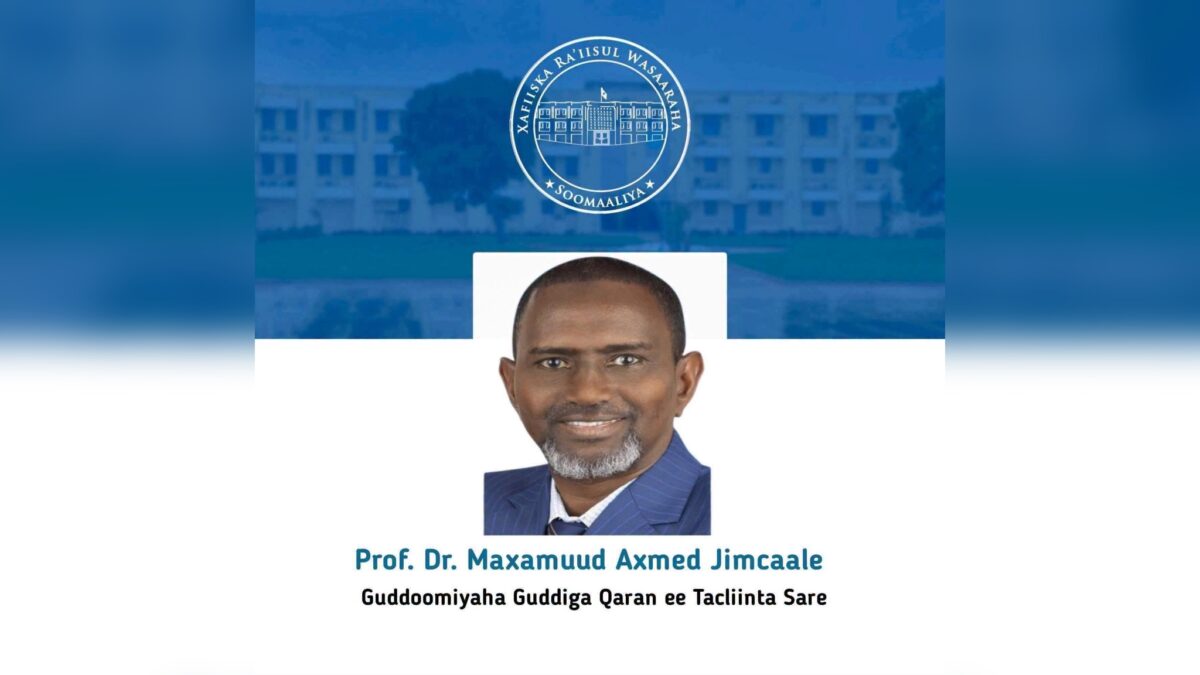
The Office of the Prime Minister of the Federal Government of Somalia has appointed Prof. Dr. Maxamuud Axmed Jimcaale as Chairperson of the National Commission for Higher Education, a move expected to strengthen quality assurance, university governance and academic standards as the country presses ahead with reforms across the education sector.
Prof. Jimcaale will head the commission responsible for advising the government on higher education policy, overseeing institutional accreditation, promoting quality assurance and ensuring universities comply with national academic standards.
The appointment follows the Federal Government’s decision in July 2025 to establish a 15-member National Higher Education Committee to oversee policy development, regulation, quality assurance and accreditation across Somalia’s universities.
The committee was formed through a merit-based selection process as part of broader reforms aimed at improving governance and raising academic standards.
The appointment also comes as Somalia continues implementing wide-ranging education reforms aimed at building a transparent, technology-driven and internationally competitive education system.
In recent years, the Ministry of Education, Culture and Higher Education has introduced the Higher Education Management Information System (HEMIS), a digital platform that enables authorities to collect and manage data from universities nationwide.
The system supports university accreditation, quality assurance, institutional monitoring and evidence-based policymaking while allowing the ministry to track student enrolment, graduation rates, academic programs and staffing.
The ministry has also strengthened inspections and quality assurance assessments of universities to ensure compliance with the National Higher Education Act and minimum standards governing teaching, governance, infrastructure and academic programs.
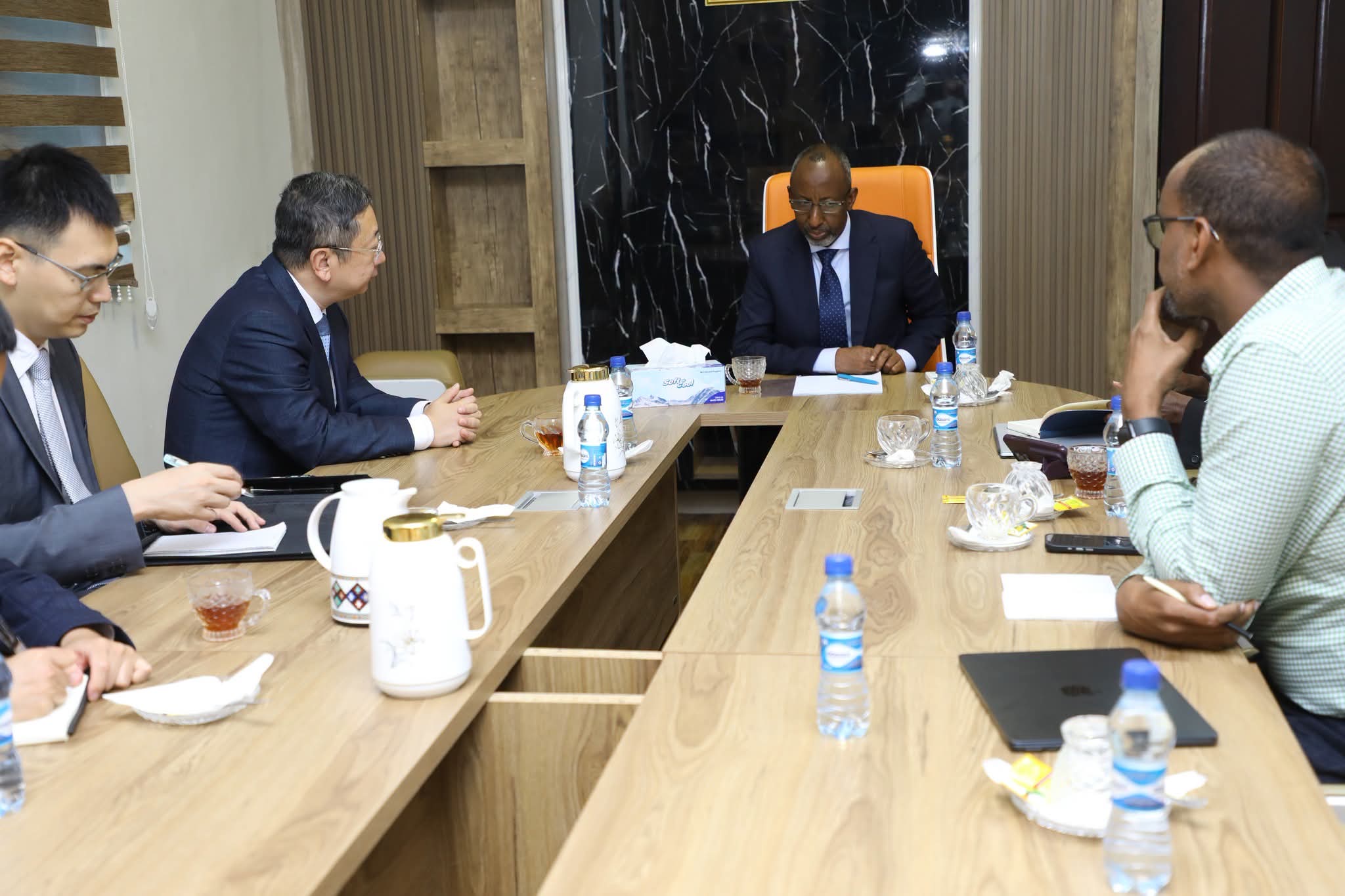
Minister of Education, Culture and Higher Education Farah Sheikh Abdulkadir welcomed Chinese Ambassador to Somalia Wang Yu to his office, where they discussed strengthening the Somalia–China strategic partnership, with a focus on education, improving learning quality and expanding educational opportunities ( Photo Courtesy: MED)
The latest appointment builds on a decade of reforms that have transformed Somalia’s education sector.
After more than two decades without a unified national examination system following the collapse of the central government in 1991, Somalia reintroduced centralized secondary school examinations in 2015.
Since then, the Federal Ministry of Education, Culture and Higher Education has administered annual Form Four national examinations across most Federal Member States, restoring a nationally recognized secondary school certification system.
Puntland State remains the only Federal Member State that does not participate in the Federal Government’s centralized Form Four examinations. Instead, it administers its own secondary school examinations through the Puntland Ministry of Education under a separate examination system.
In recent years, the ministry has also introduced the Education Management Information System (EMIS) for primary and secondary schools. The digital platform has modernized student record management by assigning learners unique identification profiles that enable education authorities to track students throughout their academic journey.
The system has significantly improved the management of student transfers by enabling schools to verify learners’ academic records before admission.
It has also helped eliminate long-standing loopholes that previously allowed some students to transfer between schools without official documentation or falsely claim to have completed classes they had not attained.
Before the introduction of EMIS, schools relied largely on manual records, making it difficult to verify students’ academic progression.
Education officials say the digital system has strengthened accountability by allowing schools and education authorities to verify each student’s enrolment history, class progression, transfer records and eligibility for national examinations through a centralized database.
Hussien Ali Sahal, Adado District Education Officer, said the Education Management Information System (EMIS) is improving the accuracy and accessibility of student records across the education system.
“EMIS is helping us move away from fragmented paper records towards a more reliable system in which each student’s educational history can be traced. When a learner transfers from one school or district to another, education officials can verify the student’s identity, grade level and previous enrolment more quickly, reducing lost records, duplication and unnecessary delays. “The DEO said
Mahad Mohamud Salaad, a teacher trainer at Galmudug Teachers Training College, said the Higher Education Management Information System (HEMIS) has the potential to improve oversight and strengthen data-driven decision-making across Somalia’s higher education sector.
“HEMIS gives the government a clearer picture of what is happening across higher-education institutions. It can provide dependable information on universities, programmes, lecturers, enrolment and graduation, enabling regulators to identify gaps and make decisions based on evidence rather than estimates,” Mahad said in an interview with Frontier Online News.
Amina Sheikh Abdullahi, a Mogadishu-based education expert, said the government’s reforms mark important progress but must be implemented more evenly across the country.
“Somalia’s education reforms are moving the sector towards greater coordination, standardization and public accountability.
The introduction of digital information systems, national standards and stronger institutional oversight represents important progress, but implementation must reach schools and universities outside the major urban centers,” Abdullahi told Frontier Online News in a telephone interview