By Hassan Adan
Students at the Somali National University have showcased 10 artificial intelligence projects as the institution steps up efforts to promote technological innovation, research and the development of locally driven digital solutions.
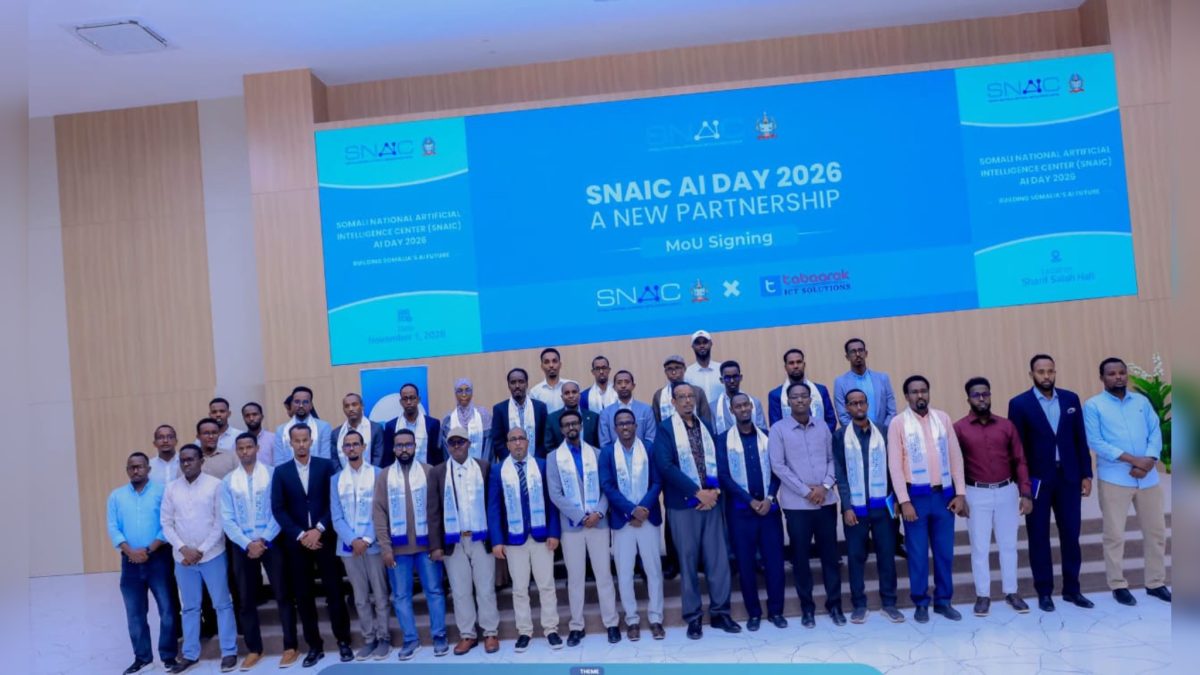
The projects were presented on Sunday during an event organised by the Somali National Artificial Intelligence Centre (SNAIC) at the Sharif Salah Auditorium on the university’s KM4 campus in Mogadishu.
The event also saw the signing of a cooperation agreement between SNAIC and Taabarak ICT, aimed at strengthening collaboration in artificial intelligence and technology development.
In addition to the student exhibitions, academics from the university presented research topics on artificial intelligence, highlighting the growing role of AI in higher education, scientific research and technological development.
The centre also unveiled its official website, a platform intended to expand access to information about its activities and strengthen the dissemination of knowledge on artificial intelligence.
Government agency directors, representatives of universities, university administrators, lecturers and students attended the event.
The latest initiative builds on the university’s establishment of the Somali National Artificial Intelligence Centre in July 2026, positioning it as a hub for AI research, education, innovation and capacity building.
According to the University officials the centre’s mandate includes developing local expertise, supporting technological entrepreneurship, promoting responsible AI governance and encouraging research into solutions addressing Somalia’s development priorities.
The centre focuses its research on machine learning, natural language processing, data science, computer vision, robotics and AI ethics, with the aim of developing practical applications across key sectors, including education, healthcare, agriculture, governance and economic development.
According to SNAIC officials, the initiative is also aimed at strengthening cooperation between universities, government institutions and technology companies to accelerate the development of Somalia’s digital economy.
Somali National University Rector Prof. Dr. Mohamed Mohamud Mohamed said the university was committed to advancing research, embracing technological innovation and strengthening academic partnerships to help address Somalia’s development challenges, adding that knowledge and innovation would be central to the country’s future.
“Together, we can build a future where knowledge and innovation drive Somalia’s progress,” he said.
The rector said the university was also prioritising curriculum reform, expanded research opportunities and the integration of digital technologies into teaching to better prepare graduates for the demands of a changing global economy.
The latest AI showcase reflects those priorities, particularly the emphasis on student-centred learning, research and the development of practical technological skills.
As artificial intelligence becomes increasingly important across education, business, healthcare and public administration, universities are facing growing pressure to equip graduates with the skills needed to participate in the emerging digital economy.
As technology becomes increasingly central to the global economy, building local expertise in artificial intelligence could help Somali institutions and businesses develop home-grown solutions to challenges in public service delivery, agriculture, education and other key sectors.
In January 2025, the Federal Government’s Council of Ministers approved the Inclusive Digital Policy and the Accelerated Governance Strategy for 2025–2029, which places emphasis on modernising government services, expanding digital skills and strengthening telecommunications infrastructure.
The government subsequently advanced consultations on its Digital Transformation Strategy for 2025–2030, with the Ministry of Communications and Technology and the International Telecommunication Union bringing together public institutions and telecommunications operators to discuss the country’s digital roadmap.
The National Communications Authority also convened the Second AI Summit Somalia 2026 in June, bringing together government officials, universities, technology experts, researchers and entrepreneurs to examine artificial intelligence applications in public services, healthcare, education, agriculture and entrepreneurs to examine artificial intelligence applications in public services, healthcare, education, agriculture and cybersecurity
Established in 1954, the Somali National University become the country’s only national university in 1969 but shut down in 1991 following the collapse of the central government. After more than two decades of closure, it reopened in 2014 as part of efforts to revive higher education and restore the country’s academic institutions.