By Hassan Adan
Somalia is set to establish its first genomics laboratory following the groundbreaking of a new specialised medical facility at Dr. Sumait Hospitals, affiliated with SIMAD University, in a development aimed at strengthening the country’s capacity for advanced medical testing, research and specialist healthcare.
The new facility, whose construction is being funded by the Kuwait-based Direct Aid organisation, will include a genomics laboratory, modern inpatient and outpatient departments, advanced diagnostic imaging equipment and dedicated spaces for patient reception and medical consultations.
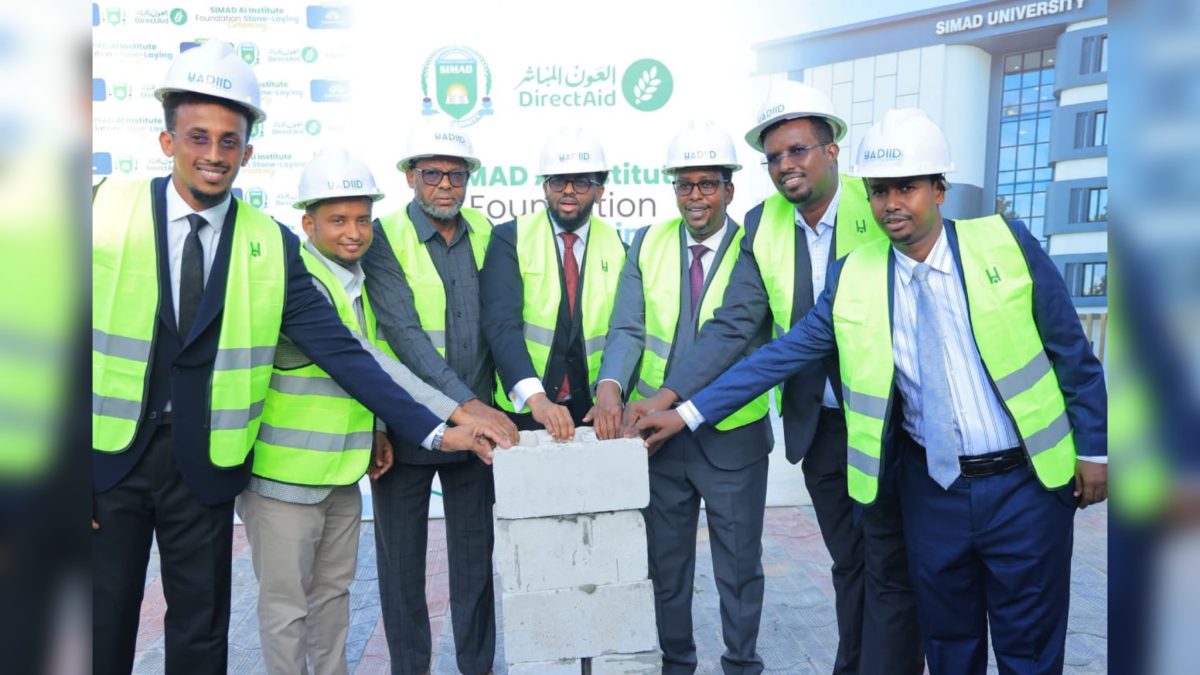
The foundation stone was laid by SIMAD University Rector Dr. Abdikarim Mohaidin Ahmed, Direct Aid Somalia Director Mohamed Sheikh Bashir and Yusuf Hassan Isak, Director General of Somalia’s Ministry of Health and Social Care.
Speaking after laying the foundation stone, SIMAD University Rector Dr. Abdikarim Mohaidin Ahmed said the projects reflected the university’s ambition to contribute to Somalia’s development through investment in education, healthcare, research and innovation.
“Our vision goes beyond providing university education. We want to build institutions that produce knowledge, advance scientific research, introduce innovative solutions and address some of the most pressing challenges facing our society. These projects represent our commitment to investing in Somalia’s future,” he said.
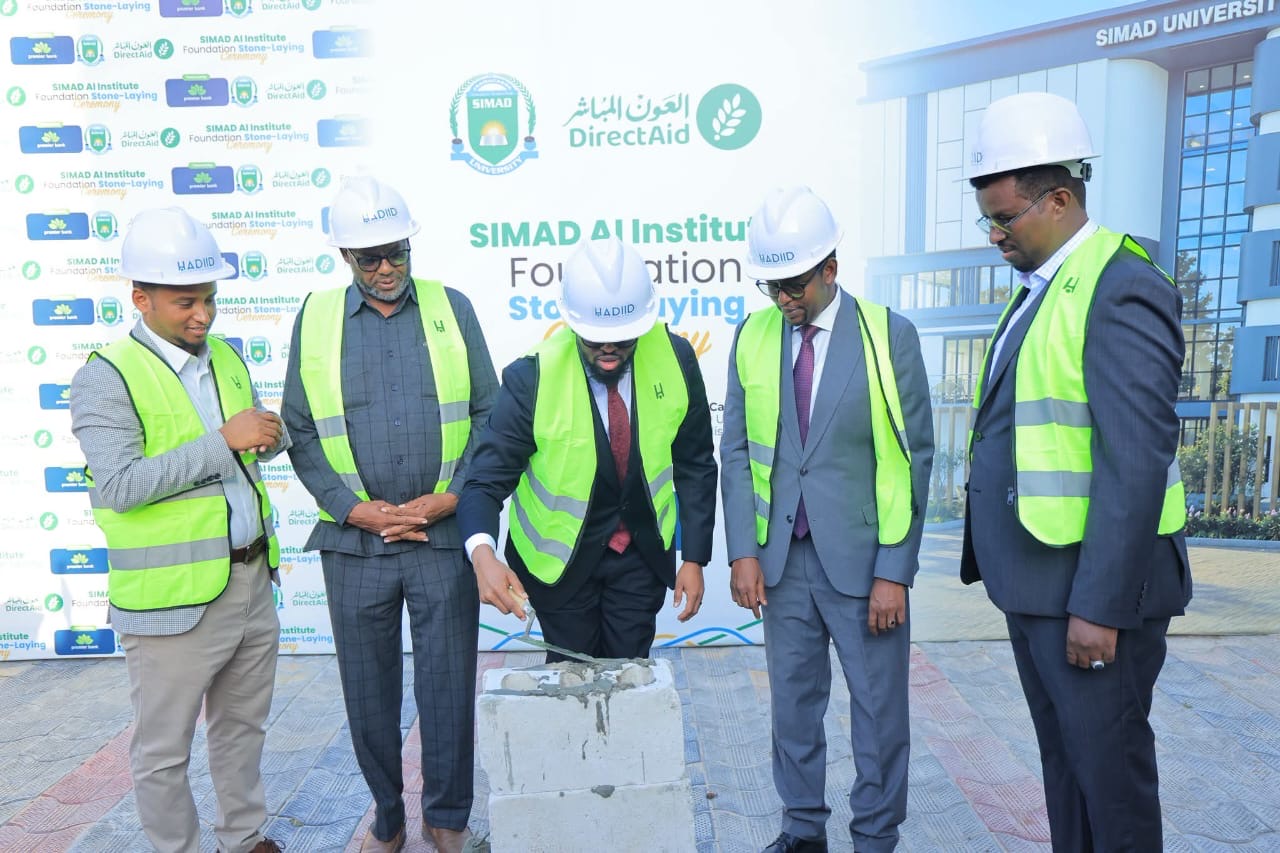
Somalia’s Minister of Communications and Technology, Mohamed Adan Macallin Ali (Mohamed Soomaali), joins SIMAD University Rector Dr. Abdikarim Mohaidin Ahmed and SIMAD AI Institute Director Dr. Yahye Abukar Ahmed during the foundation-stone laying ceremony for the new SIMAD AI Institute building in Mogadishu.
This latest project comes as Somalia continues to face challenges in expanding access to specialised medical services, with many patients seeking advanced treatment outside the country.
The planned expansion is expected to strengthen local diagnostic and research capabilities while creating opportunities for the training of healthcare professionals.
Genomics, the study of an organism’s complete genetic material, has applications in identifying inherited conditions, understanding diseases and supporting more precise approaches to diagnosis and treatment.
Establishing such laboratory capacity could create new opportunities for medical research and specialised diagnostics in Somalia.
The planned investment comes amid growing calls from Somali health professionals for greater investment in medical research, laboratory infrastructure and specialised diagnostic services to address longstanding gaps in the country’s healthcare system.
Yusuf Hassan Isak (Yusuf Wadani), Director General of the Federal Ministry of Health and Social Care, described the initiative as “a major milestone for Somalia’s health sector”, highlighting the importance of reliable health information in strengthening healthcare planning, resource allocation and service delivery.
Senator Prof. Dr Osman Mohamud Mohamed Dufle, a prominent Somali physician and chairman of the Upper House Committee on Social Services, commended SIMAD University’s investment, saying the expansion of specialised medical facilities could help raise healthcare standards and strengthen professional capacity.
“Investing in modern medical facilities is an important step towards improving the quality of healthcare in Somalia. We need institutions that can support specialised treatment, strengthen medical research and ensure that patients receive safe and professional care,” he said.
Dr Hodan Duale, Director of the Somali Institute for Health Research, also welcomed the university’s initiative, urging the Federal Government, particularly the Ministry of Health, to work closely with academic institutions investing in medical research and healthcare development.
“Universities cannot do this work alone. The government must work alongside institutions such as SIMAD to turn research and innovation into practical improvements in healthcare. What SIMAD is doing is commendable, and such initiatives deserve institutional support and stronger collaboration,” she said.
The experts’ views underscore the importance of the planned investment at Dr. Sumait Hospitals as Somalia seeks to expand specialised diagnosis, strengthen domestic medical research and develop a skilled healthcare workforce.
A 2025 scientific study involving Somali public health laboratory experts documented that improvements in the country’s diagnostic capacity following investments made during the COVID-19 pandemic, while highlighting the need for continued development of laboratory infrastructure and skilled personnel.
In September, Dr. Sumait Hospitals announced an agreement with India’s Yashoda Hospitals, a multi-specialty healthcare network, to strengthen specialist services, medical training and professional knowledge exchange.
The partnership provides for specialist medical consultations, clinical training for Somali doctors and medical students, medical campaigns, telemedicine services and opportunities for advanced professional training.
It is also intended to help patients access specialised healthcare closer to home.
The medical project is part of a wider expansion by SIMAD University, which has also broken ground on a new building for its artificial intelligence institute and a facility for its Center for Professional Examinations as the institution marks its 27th anniversary.
The new AI Institute building is expected to strengthen the university’s capacity for artificial intelligence education, research and innovation.
Speaking after the foundation-stone ceremony, Director of the SIMAD AI Institute Dr. Yahye Abukar Ahmed said the new building would provide an expanded platform for artificial intelligence research, innovation and the development of local technological expertise.
“Our ambition is to ensure that Somali students and researchers are not simply consumers of artificial intelligence technologies but also become innovators capable of developing solutions to our own challenges. This institute will help nurture local talent, strengthen research and connect Somalia to the rapidly growing global AI ecosystem,” he said.
SIMAD established the institute as Somalia’s first university-based artificial intelligence institution, bringing together students, researchers and professionals to explore
As artificial intelligence increasingly transforms healthcare, education, agriculture, business and public administration worldwide, developing local expertise could help Somalia nurture a generation of technology specialists capable of designing solutions to domestic challenges.
The university’s Center for Professional Examinations is also expanding its facilities to provide greater access to internationally recognised professional qualifications.
Through authorised examination arrangements with organisations including ACCA and Pearson VUE, the centre enables Somali students and working professionals to undertake recognised computer-based examinations in Mogadishu rather than travelling abroad.
The development is particularly relevant as Somali graduates seek professional qualifications that can improve their competitiveness in regional and international employment markets.
In October, Prime Minister Hamza Abdi Barre laid the foundation stone for a new Science and Technology Campus in Mogadishu’s Deynile district.
The proposed 84,000-square-metre campus is designed to accommodate up to 15,000 students and will include 91 classrooms, 30 lecture halls, 36 specialised laboratories and three libraries, alongside student accommodation, sports facilities and other academic services.
The project is being undertaken in partnership with Direct Aid, a Kuwait-based humanitarian and development organisation, with construction expected to take up to four years.
Established in November 1999, SIMAD began as an institute of higher learning before acquiring university status in 2011.
Over the years, it has expanded its academic programmes, research activities and institutional partnerships.
The university’s growing investment in healthcare, science and technology comes as Somalia seeks to rebuild public services and strengthen domestic expertise after decades of conflict and institutional disruption.