By Hassan Adan
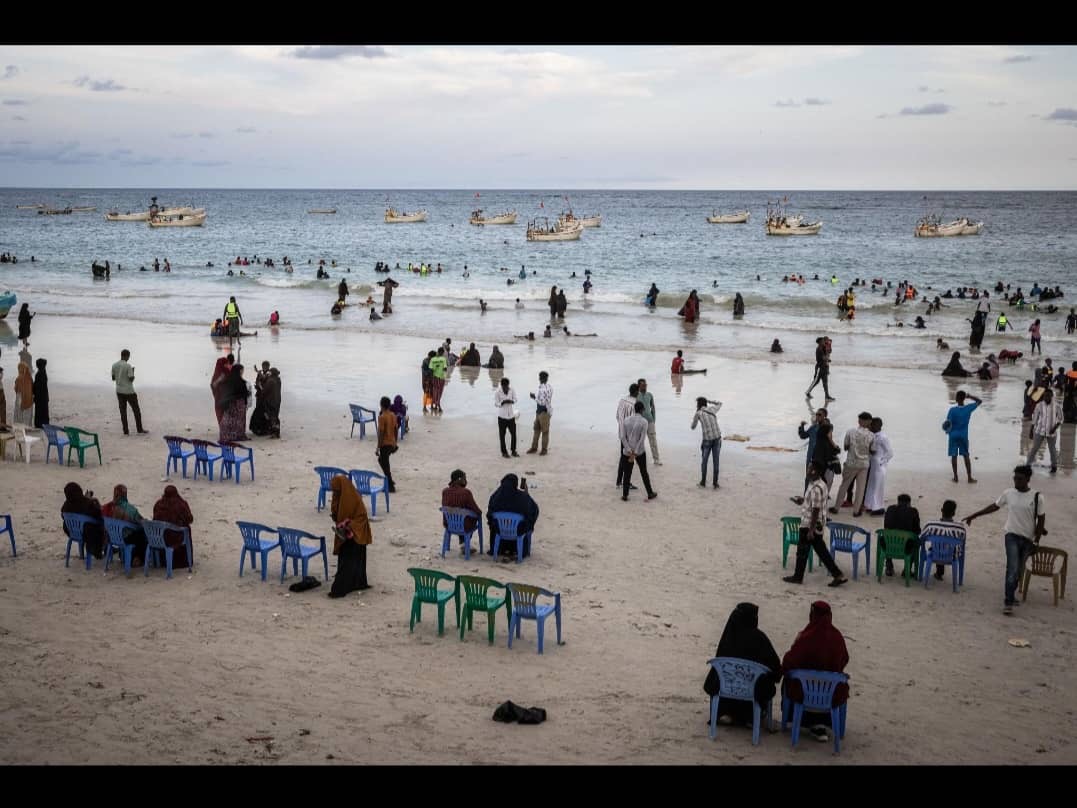
As the afternoon sun softens over the Indian Ocean, laughter rises above the surf at Lido Beach, where young men dive into rolling waves, elderly men wade cautiously through the shallows, and women in flowing hijabs stand ankle-deep in the water, watching children chase foam racing along the shoreline.
It is Thursday in Mogadishu — the start of the weekend in Somalia — and by midday, the city’s most famous beachfront is alive with thousands of residents escaping the demands of another working week.
The scent of salt drifts through the humid air as plastic chairs sink gently into the sand.
Waiters weave through the crowd carrying dented kettles filled with steaming cardamom tea, pouring into small glass cups as customers lean back and let the ocean breeze do what no medicine can.
Just above the shoreline, beachside hotels overlooking the Indian Ocean are equally packed.
Families, businesspeople and young couples fill balconies facing the sea, sipping tea and fresh juice as they watch swimmers below.
On Thursdays and Fridays, finding an empty chair in many of the seaside hotels has become a matter of luck as residents pour into Lido in search of rest, fresh air and a glimpse of a city rediscovering itself.
For a city once defined by checkpoints, mortar blasts and hurried footsteps, the scene feels almost improbable.
Yet in Mogadishu, normalcy is no longer whispered — it is increasingly lived.
“Mogadishu residents are beginning another day with a quiet insistence on normalcy,” said Zamzam Abdullahi, a mother of six who rents plastic chairs and swimming vests to beachgoers eager to enter the water.
Her eyes followed a group of boys kicking a football across the wet sand.
“Here, the ocean reminds us we are still alive,” she said with a smile as customers gathered around her small business.
A few metres away, university students lounged beneath umbrellas, notebooks open beside mobile phones, debating exams, politics and football scores — conversations once drowned out by fear.
“We come here to relax, to think, to dream,” said Hussein Ibrahim, a political science student.
“Peace starts in moments like this.”he added
As we moved through the growing crowd, an unexpected scene unfolded.
A senior government official, accompanied by only two aides and no visible armed convoy, quietly walked onto the beach. Children paused their football match before rushing toward him.
He shook hands, exchanged jokes and kicked the ball back toward them.
Minutes later, beachgoers whispered his name — it was Ahmed Moalim Fiqi, Somalia’s Minister of Defence.
The moment, almost ordinary by global standards, carried extraordinary symbolism in a city that spent decades under the shadow of conflict.
Since the collapse of Somalia’s central government in 1991, Mogadishu has endured civil war, clan violence, insurgency and relentless attacks by the militant group Al-Shabaab.
Entire neighbourhoods were emptied, friendships interrupted, and a generation grew up knowing checkpoints better than playgrounds.
But over the past several years, residents say the capital has undergone a quiet transformation.
New cafés remain open late into the night.
Families stroll along the beachfront after sunset. University campuses are crowded again.
Construction cranes rise above neighbourhoods where bullet-scarred buildings once stood.
Along major roads, junctions and public spaces, hundreds of security cameras have been installed as part of a broader effort to improve public safety and strengthen law enforcement capabilities.
Residents and security officials say the expanding surveillance network, combined with increased policing and community cooperation, has contributed to a greater sense of security in many parts of the city.
The changes are visible not only on the streets but also in the confidence of ordinary citizens who increasingly move through the capital without the constant fear that once defined daily life.
President Hassan Sheikh Mohamud has repeatedly pointed to the growing calm in Mogadishu as evidence of Somalia’s resilience, even as security forces continue military operations against Al-Shabaab in other parts of the country.
“A peaceful Mogadishu is not just a dream; it is becoming a reality built by the resilience of our people,” the president said during a recent public address.
For residents like Sadiiq Kulmiye in Abdiaziz district, home to Lido Beach, the transformation is deeply personal.
“Many of the young people here never saw the old Mogadishu — the cinemas, the music, the families walking freely,” he said while gazing at the waves.
“They know only stories. But when you stand here today, you feel maybe those stories are coming back.”
As dusk settled over the shoreline, the call to prayer echoed across the city, blending with the sound of crashing waves and children’s laughter.
On the sands of Lido, Mogadishu did not look like a city emerging from war.
It looked, if only for an evening, like a city finally learning how to breathe again.