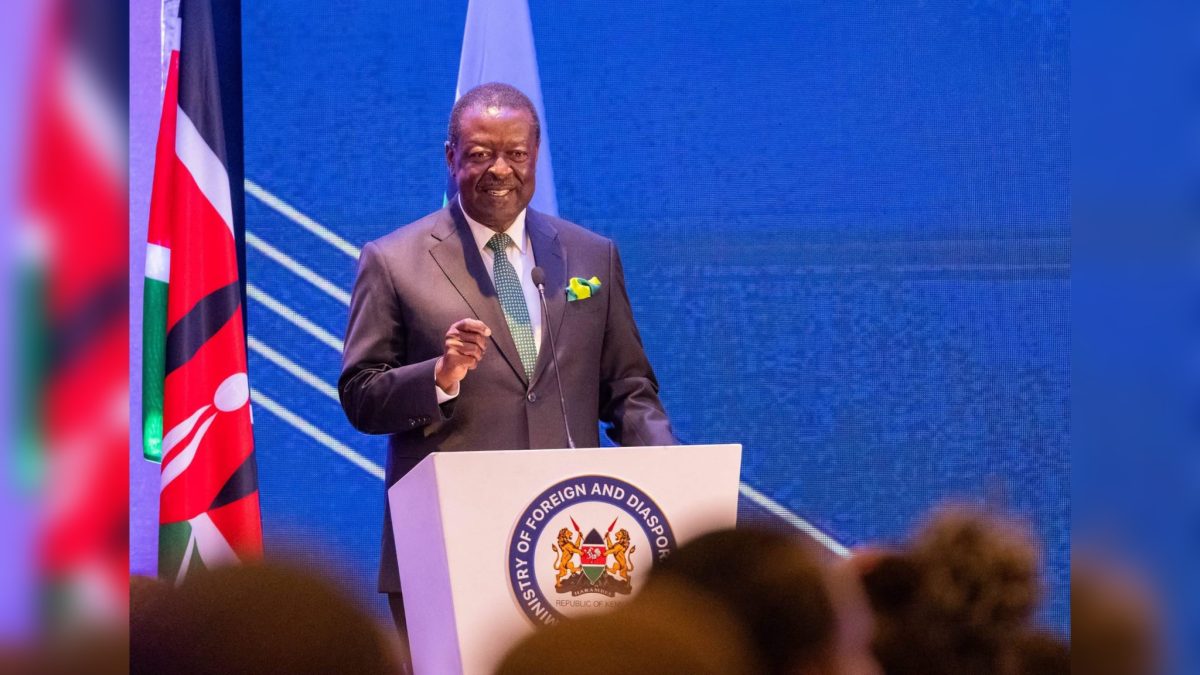
NAIROBI – Prime Cabinet Secretary and Cabinet Secretary for Foreign and Diaspora Affairs Musalia Mudavadi has called on governments, public institutions and international organisations to prioritise honesty, accountability and fairness, saying public trust must be earned through actions rather than promises.
Mudavadi said institutions risk losing public confidence when they fail to fulfil commitments, urging leaders to abandon practices that undermine trust and strengthen transparency in governance.
Speaking on Thursday, October 22, 2026, during the opening of the Trust Summit 2026: The Nairobi Dialogue on Global Trust in Nairobi, Mudavadi said trust was fundamental to the stability of institutions, economic prosperity and international cooperation.
“We cannot demand that people believe us, we must give them reasons to do so. We cannot legislate trust, we can practise the honesty, fairness and accountability from which it grows,” he said.
The summit, held under the theme “Weaving Trust: Binding Strands for a Stronger Global Order,” brought together representatives from government, civil society, business, development partners, academia, the media, technology companies and international institutions.
Mudavadi warned that institutions should not confuse activity with impact or meetings with genuine public confidence, arguing that trust develops when leaders honour their promises, acknowledge mistakes and take corrective action.
“Trust grows when words and actions agree, when promises are honoured and when mistakes are acknowledged and corrected,” he said.
He challenged participants to ensure the summit produces concrete commitments rather than ending with speeches and declarations that are not followed by implementation.
“This Summit must leave Nairobi with more than eloquent speeches and an impressive communique,” Mudavadi said, calling for a clear call to action, a framework outlining responsibilities, a coalition of actors and a credible mechanism to monitor delivery.
He said the credibility of institutions depended on their willingness to remain transparent, answerable and open to scrutiny, cautioning against treating public confidence as a substitute for accountability.
Citing an Afrobarometer working paper based on survey data from 37 African countries, Mudavadi said the findings associated greater trust in presidents and ruling parties with weaker public support for accountability mechanisms, including parliamentary oversight, media scrutiny and citizens’ ability to hold governments accountable.
He argued that trust and accountability should reinforce each other, adding that institutions should inspire confidence through their conduct while remaining subject to scrutiny.
“The strongest institutions are not those that ask people to trust them blindly, but those that inspire confidence through their conduct while remaining transparent, answerable and open to scrutiny,” he said.
Mudavadi also highlighted the role of science and technology in shaping public confidence, noting that scientific evidence alone may not be sufficient to build trust if people feel excluded from the benefits of research and innovation.
Referring to the Wellcome Global Monitor 2026, he said the proportion of people who believed most people in their country benefited from science had declined from 42 per cent in 2018 to 37 per cent in 2025.
He said institutions needed to demonstrate fairness, improve access to healthcare and respond to public concerns to strengthen confidence in scientific research.
The Prime Cabinet Secretary further warned that misinformation and deliberate disinformation circulating on social media could deepen suspicion and damage reputations before facts are established.
While acknowledging that social media had expanded public participation and given more people a voice, he said freedom of expression should not be interpreted as permission to fabricate or deliberately distort information.
Mudavadi also called for religious, cultural and traditional leaders to play a greater role in discussions on trust, saying moral authority depended on consistency between words and conduct.
He noted that families were the starting point for building trustworthy societies because they instilled values such as honesty, respect, responsibility and compassion.
“These values are then carried into our schools, communities, businesses, public institutions and, ultimately, the nations in which we live,” he said.
On international cooperation, Mudavadi said global institutions needed to earn confidence through fairness, representation and delivery.
He singled out Africa’s lack of a permanent seat on the United Nations Security Council as a question of legitimacy.
He argued that permanent African representation, consistent with the African Union’s Common African Position, would strengthen the continent’s participation in decisions affecting international peace and security.
“A more representative United Nations would strengthen the trust upon which effective multilateral cooperation depends,” he said.
Kenya, he added, remained committed to multilateral cooperation because challenges such as climate change, peace and security, public health, trade and technological change crossed national borders.
Mudavadi called on the summit’s participants to translate their discussions into practical measures that would improve institutional credibility and strengthen relationships between governments and citizens.
He said Nairobi should be remembered not merely as the venue where global leaders discussed trust, but as the place where they renewed their commitment to becoming more trustworthy.
“It is my wish that Nairobi be remembered not simply as the place where the world discussed trust, but as the place where we strengthened our resolve to become more trustworthy,” he said before officially declaring the summit open.
The dialogue seeks to address the foundations of trust in public institutions, economic relationships and international cooperation, with an emphasis on turning commitments into measurable action.