By Hassan Adan
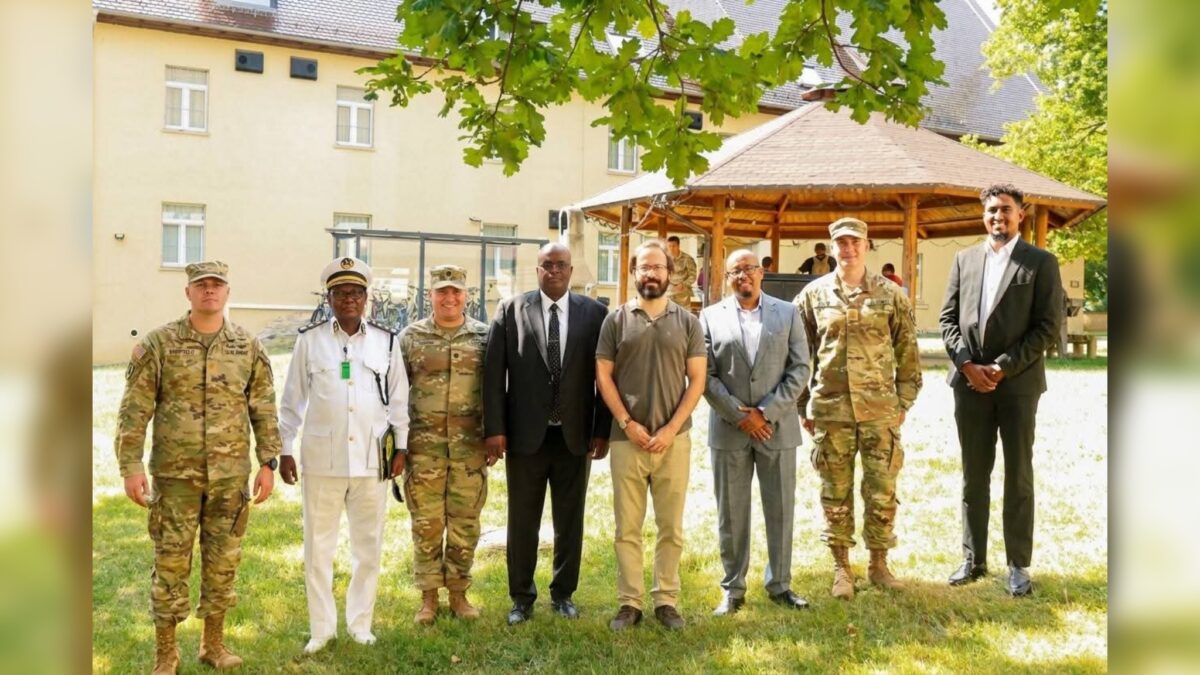
The United States Africa Command (AFRICOM) has hosted a high-level Somaliland government delegation at its headquarters in Stuttgart, Germany, where the two sides discussed expanding defense cooperation, maritime security and efforts to promote peace and stability in the Horn of Africa.
The delegation was led by Somaliland Defense Minister Mohamed Yusuf Ali and included Somaliland Coast Guard Commander Adam Ahmed Hurre Hariye, senior presidential adviser Farah Ahmed Habush and academic commandant Abdiasis Ahmed.
According to the ministry of defense somaliland, the meeting focused on strengthening the strategic partnership between Somaliland and the United States through enhanced defense cooperation and efforts to build the capacity of Somaliland’s military and security institutions.
“The meeting focused on strengthening the strategic relationship between Somaliland and the United States, discussing ways to expand defense cooperation and develop the capabilities of security institutions,” the ministry said in a statement.
The two sides also discussed maritime security in the strategically important Bab el-Mandeb Strait and the Red Sea, key international shipping corridors linking Europe, Asia and the Middle East.
Officials explored ways to counter emerging security threats, protect global trade routes and enhance regional stability.
The ministry said both delegations also exchanged views on strengthening peace and security across the Horn of Africa, emphasizing the importance of improving the operational capacity of military and security institutions to respond to evolving regional challenges.
“This preliminary agreement is an important step toward strengthening maritime security and Somaliland’s role in promoting regional and international security,” the ministry added.
The meeting comes amid increasing engagement between U.S. military officials and authorities in both Mogadishu and Hargeisa.
Although Washington maintains security cooperation with Somaliland on issues such as maritime security and counterterrorism, the United States continues to recognize the sovereignty and territorial integrity of the Federal Republic of Somalia and does not recognize Somaliland as an independent state.
Somaliland declared independence from Somalia in May 1991 following the collapse of Somalia’s central government after the fall of President Mohamed Siad Barre’s regime.
Since then, the self-governing territory has maintained its own government, parliament, judiciary, currency and security forces while seeking international recognition as a sovereign state.
Successive Somali governments have consistently rejected Somaliland’s independence claim, insisting that Somaliland remains an integral part of the Federal Republic of Somalia.
Mogadishu has repeatedly stated that any country recognizing Somaliland or entering agreements that undermine Somalia’s sovereignty would violate its territorial integrity and international law.
On December 2025, Israeli Prime Minister Benjamin Netanyahu, in a video call with Somaliland President Abdirahman Mohamed Abdullahi “Cirro,” announced that Israel had recognized Somaliland as an independent state, making it the first UN country to do so.
President Cirro later traveled to Israel, where Somaliland formally opened an embassy in Jerusalem (Al-Qudus), a move welcomed by Israeli officials but strongly condemned by Somalia.
The Somali federal government described Israel’s recognition of Somaliland and the establishment of the diplomatic mission as a direct violation of Somalia’s sovereignty and territorial integrity, warning that the move threatened regional stability.
Jerusalem, known as Al-Qudus in Arabic, holds profound religious significance for Muslims as the home of Al-Aqsa Mosque, located in occupied East Jerusalem, is the third holiest site in Islam after the Masjid al-Haram and Al-Masjid an-Nabawi.
It is revered as the place from which the Prophet Muhammad (peace be upon him) is believed to have ascended to heaven during the Isra and Mi’raj (Night Journey).
The mosque and its surrounding sanctuary hold profound religious and historical significance for more than 1.9 billion Muslims worldwide and have remained at the heart of the Israeli-Palestinian conflict, making any perceived change to its status or access arrangements highly sensitive and a source of regional and international tension.