By Hassan Adan
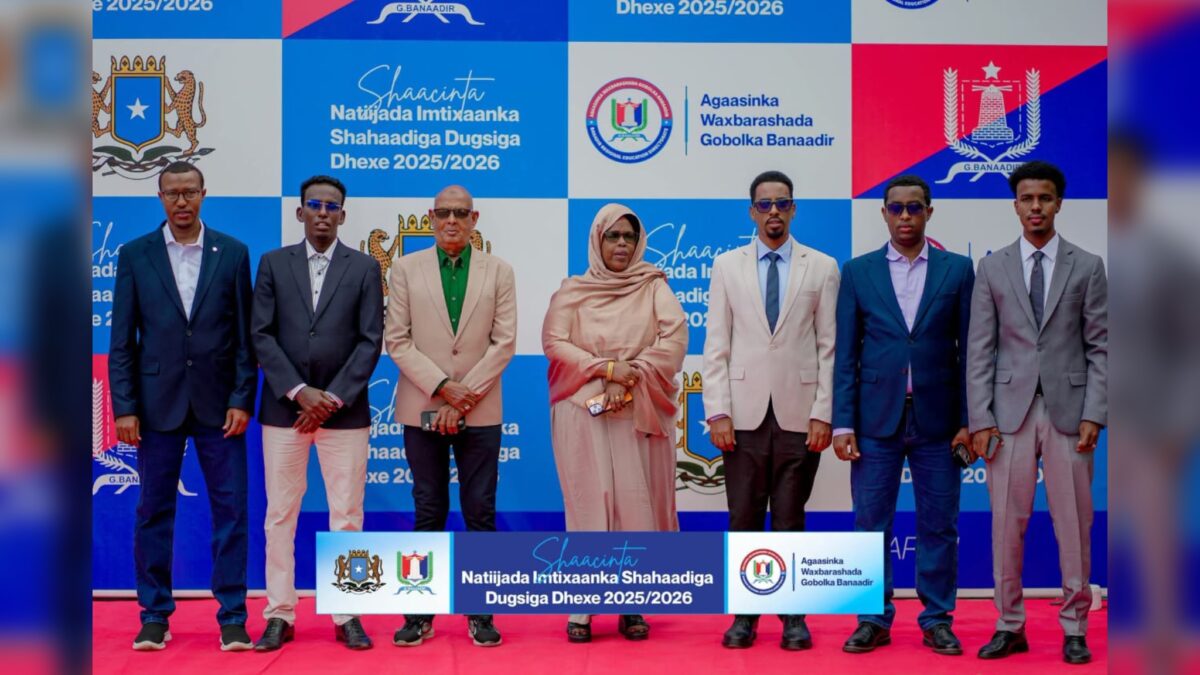
Education authorities in Somalia’s Banadir regional administration on Sunday announced the results of the Grade 8 certificate examinations, with 44,017 of the 45,452 students who sat the tests passing, according to official figures.
The results represent a pass rate of 96.8%, while 1,435 students, or 3.2%, did not pass, the Banadir Regional Education Directorate said.
The examinations were held from June 15 to June 18, with students tested in Somali, Arabic, Islamic Studies, Mathematics, English, Science and Technology.
Of the 45,452 candidates who sat the examination, 23,351 were boys and 20,666 were girls, the authorities said.
Sumaayo Hassan Abshir Aadan of Mahmoud Harbi School in Warta Nabadda district emerged as the top-performing student, scoring 96.88%.
Balqiisa Mohamed Omar Mohamed of Geerle School in Dayniile district ranked second with 96.25%, while Ahmed Abdinasir Abdullahi Abdi of Al-Basa’ir Al-Mithaliyah School in Dayniile ranked third with 95.88%, according to the results.
The Banadir administration said students dissatisfied with their results could request a review of their examination papers.
Different examination systems
Somalia’s examination system is divided between federal and regional authorities.
The Federal Government administers the centralized national Form Four, or Grade 12, examination for students completing secondary education.
The federal Ministry of Education sets the examination and oversees its administration in areas participating in the national system.
Grade 8 examinations, however, are administered separately by regional education authorities.
Federal member states generally set and conduct their own Grade 8 examinations, with regional authorities responsible for preparing examination papers, administering the tests and releasing the results.
Banadir, which hosts the federal capital Mogadishu, therefore sets and administers its own Grade 8 examination.
The arrangement reflects Somalia’s federal system, under which education responsibilities are shared between the Federal Government and member states.
Puntland runs its own examinations
Puntland operates its own education and examination system, including separate Grade 8 and Form Four examinations.
Students in Puntland sit the Form Four examination administered by the Puntland Ministry of Education rather than the Federal Government’s centralized secondary-school examination.
After completing Form Four, Puntland students who plan to pursue university education outside Somalia may submit their certificates to the Federal Ministry of Education for verification and certification.
The federal verification provides official authentication of certificates issued under Puntland’s education system when graduates need recognition for university admission or other purposes outside the regional system.
Puntland’s separate examination arrangement is linked to the development of the regional administration’s education institutions and curriculum.
Puntland was established as a regional administration in 1998, before Somalia later developed a federal government and a centralized national curriculum and examination framework.
As a result, Puntland has maintained its own curriculum and examination authorities while remaining part of the federal structure of Somalia.
Somaliland, which has operated a separate administration since declaring independence from Somalia in 1991, also maintains its own education, curriculum and examination system.
Its students similarly follow an education system separate from the Federal Government’s national examination framework, with certificates subject to verification when recognition is required outside that system.
Somalia’s national examination system was effectively dismantled after the collapse of the central government in 1991, when the country lost a functioning nationwide education and examination authority.
The Federal Government reintroduced national examinations in 2015, marking an effort to restore standardized assessment and certification after more than two decades without a functioning nationwide examination system.
The federal examination system has since expanded, particularly at secondary-school level, with the national Form Four examination becoming the principal centralized examination administered by the Federal Government.
Grade 8 examinations, however, remain largely decentralized, with regional authorities responsible for preparing and administering examinations in their respective jurisdictions.
The result is a dual examination structure: a federal centralized examination at Form Four level and regionally administered examinations at Grade 8 level.
Education challenges
The latest Banadir results come as Somalia continues efforts to rebuild its education system after decades of conflict and institutional collapse.
The country continues to face challenges including shortages of qualified teachers, inadequate school infrastructure, limited access to secondary education and disparities in education provision between regions.
For students completing Grade 8, the examination represents an important transition point before secondary education.