By Dr AbdulSalam Adan Mohamed
Introduction:
This is the story of a council born in haste—not to reform what was corrupted, but to beautify what could no longer be beautified. It reflects a persistent attempt to improve the image of a figure who never fully secured acceptance within a noble community—one that is highly sensitive to deception and possesses a long memory when it comes to disappointment.
It is the story of timing that always arrives too late, when “reform” becomes cosmetic powder and the expected role turns into an ornate rhetorical statement. As for the scholars—or those who remain on the scene—some chose flattery as a methodology and proximity to rulers as a virtue marketed under the name of wisdom. Gradually, justification became discourse, discourse became cover, and cover became a burden borne by ordinary people.
These are the stations:
- A founding moment when difficult questions were never asked.
- A role that shrank until it became a faint shadow.
- Timing that serves only a shaken image seeking a golden frame.
And between one station and another, the question remains suspended:
Was the council created to be a conscience—or merely a mirror reflecting what it is told to reflect?
First Station: The General Background
After 2013, scholars had a unifying body upon which great hopes were placed. However, that body soon fractured, splitting into “Ferfisa ” and “Tokoma.” From that point, the real crisis began to infiltrate the scholarly ranks.
Authoritarian tendencies emerged, building bridges of flattery toward politicians. The path led to outcomes known to many, reaching a regrettable state. Division and fragmentation deeply wounded the unity of the Garre community.
Following the 2022 elections, new attempts surfaced to reunify the scholars. Scholars from the Garre clan across various regions gathered under a new umbrella called “Al-Rashad.” Public funds reportedly became the hidden fuel of the project.
Dr. Adawa was appointed president and Imam Mohamud Markoni as deputy. Offices were established, and a well-furnished headquarters was opened in the capital, with two years’ rent paid in advance and substantial funds allocated.
The declared goal was to serve knowledge; the implicit aim appeared to be preparing and guiding public opinion ahead of the 2027 elections.
Over time, the structure unraveled again. Only Mr. Adawa remained in leadership, while other members were sidelined. Some were appointed to marginal county roles, including Dr. Ahmed Abdul Latif and others, reportedly with undisclosed salaries.
The recurring question remains:
Was the intention to unite voices—or to unite interests?
Reports within the Garre community suggest that resignations were not spontaneous but stemmed from growing concern that religious work had been drawn into tribal, political, and electoral paths.
Disagreements were no longer mere differences of opinion but fractures in vision and direction. Despite repeated attempts to unify agendas, divisions remain alive to this day.
Second Station: New Conflicts and Marginalization of Local Scholars
After disputes between certain scholars and political leadership, attention shifted toward village scholars as an alternative body. However, this move was limited to small groups outside the Garre clan, weakening the presence of the Al-Rashad council.
During official visits, political mobilization overshadowed religious purpose. Tribal tendencies resurfaced, and elections became the hidden axis of movement. Scholars were categorized according to loyalty and affiliation.
Local scholars view the white-robed, turbaned figures arriving from Nairobi as mere “tourists”—a term used half humorously, half critically.
Third Station: Establishing a Parallel Scholarly Body
A parallel body was established under the same leadership, expanding under the title “Somali Wayn Ulama.” While publicly framed as serving scholars and promoting unity, observers point to deeper political objectives.
Similarly, a Mandera Scholars Council was announced in Nairobi. More than two years have passed with limited visibility or measurable impact.
Again, Mr. Adawi returned to the forefront, accompanied by selected members from certain clan groups in Mandera town, while critics were sidelined.
The question remains:
Is this genuine unity—or a reshaping of influence in new clothing?
Many interpret Adawi’s continued leadership as a reflection of his political and clan proximity to decision-making circles, enabling influence over public opinion for broader political goals.
Fourth Station: Legal Framing and Official Announcement (9 February 2026)
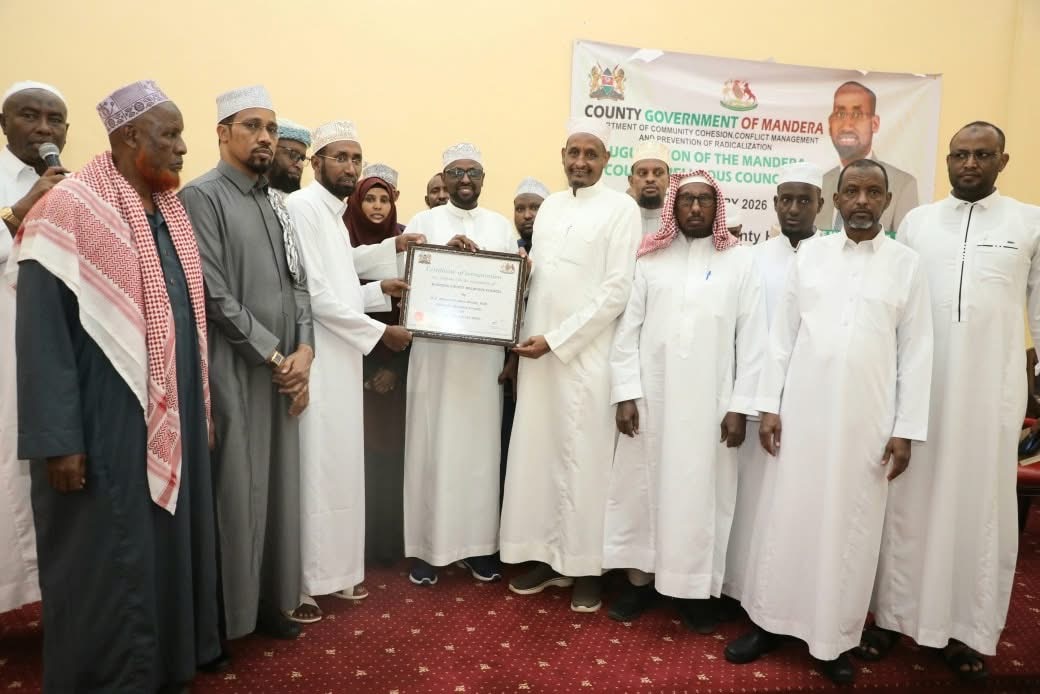
Under the pretext of peacebuilding and managing tribal conflicts, the body was granted legal status and officially announced as the “Religious Council in Mandera.” Meanwhile, local scholars were reportedly marginalized.
The new council combined peacebuilding and religious advocacy roles, yet most of the faces were new—except for Dr. Adawi.
Several questions arise:
- What is the relationship between tribal conflict management and the establishment of a scholars’ council?
- Why link school unification, funding, and scholar employment to this framework?
- Was this merely a public opinion exercise aimed at gaining artificial legitimacy and creating ambiguity before the central government?
Although the council’s goals were summarized as:
- Promoting interfaith dialogue and peaceful coexistence.
- Contributing to reconciliation and resolving community disputes.
- Supporting community stability through guidance and preaching.
These are noble principles already upheld by respected figures such as Sheikh Ahmed Sudani and others.
What raises concern is not the goals themselves—but the timing and the anticipated political role ahead of 2027.
To many observers, the council appears positioned as an electoral instrument, aimed at shaping public opinion and influencing county administration.
There is also controversy regarding the council’s founding bylaws. Even some council members reportedly have not seen the legal framework or are unaware of its official registration details.
Thus, the council operates in ambiguity—caught between declared principles and actual practice.
Conclusion: Politicization of Religious Work Ahead of 2027
Available evidence suggests an increasing use of religious institutions for political and tribal objectives.
This stands in tension with Kenya’s constitutional framework, which distinguishes religion from the state. As scholars become politically aligned and tribally categorized, they risk losing credibility and being perceived as part of the problem rather than agents of reform.
Their core religious mission weakens, and they begin to resemble interest groups serving political agendas rather than moral authorities guiding society.
Recommendations
The issue extends beyond organizational disputes—it reflects the growing overlap between religious mission and political calculation ahead of 2027.
Religious work requires moral independence, reformist neutrality, and the ability to unite diverse groups under shared values. Once independence is compromised, public trust—the true capital of any scholarly institution—erodes.
The problem is not the establishment of new councils or the promotion of peace slogans. Rather, it lies in:
- Lack of transparency in formation and legal structuring.
- Marginalization of local expertise.
- Contradictions between declared bylaws and actual practice.
- Concentration of leadership influence instead of expanding participation.
The future of the council depends on restoring trust, ensuring independence, and proving that its existence is a genuine community necessity—not a temporary political season.
The Writer, Dr. Abdulsalam Adan Mohamed
Director, Maarifa College & Educational Expert