By Hassan Adan
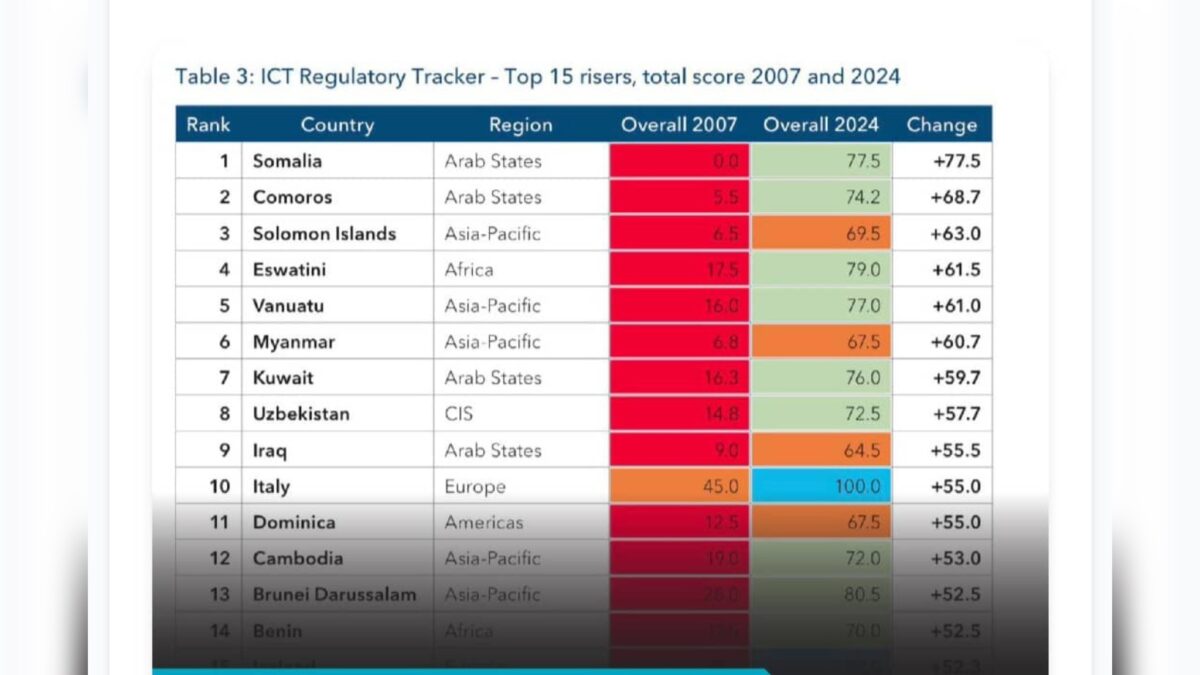
Somalia has emerged as the world’s fastest-improving country in telecommunications regulation after its score in the latest International Telecommunication Union (ITU) ICT Regulatory Tracker jumped from 0.0 in 2007 to 77.5 points in 2024, marking one of the most dramatic digital transformations recorded globally.
The ITU tracker, which measures the maturity of telecommunications regulation across 194 countries, assesses areas including regulatory independence, market competition, legal frameworks, consumer protection and investment readiness. Somalia’s sharp rise reflects nearly two decades of reforms that have transformed the country from having virtually no formal telecommunications oversight into one of Africa’s fastest-evolving digital economies.
The milestone is being viewed as a major achievement for the Horn of Africa nation, where the private sector helped build communications infrastructure even during years of conflict, allowing millions of citizens to leapfrog traditional banking and communications systems.
“This is not just a regulatory score—it reflects Somalia’s journey from recovery to digital growth,” a senior official at National Communications Authority Somalia said.
“The laws, institutions and market reforms introduced over the last several years are now producing measurable global results.”
Somalia’s communications sector received a major boost following the establishment of the National Communications Authority under the Communications Act of 2017, giving the country its first fully independent communications regulator tasked with licensing operators, managing spectrum, enforcing fair competition and protecting consumer rights.
Analysts say Somalia’s digital rise has also been powered by the country’s telecom operators, led by Hormuud Telecom, whose mobile networks, broadband expansion and digital financial services have reshaped everyday life across the country.
“Hormuud has always believed technology must solve real problems for ordinary people,” a senior Hormuud Telecom executive said.
“When people can communicate, pay, trade and support families instantly, that is when technology becomes development.”
At the center of that transformation is EVC Plus, Hormuud’s mobile money platform that has become the backbone of daily commerce in Somalia.
From street vendors in Mogadishu to livestock traders in rural regions, millions of Somalis use EVC to send and receive money, pay school fees, settle hospital bills, purchase groceries and conduct business transactions using basic mobile phones—often without needing a bank account, internet connection or physical cash.
“A mother can send money to her children instantly. A merchant can pay suppliers in seconds. A student can pay tuition without standing in line. EVC has removed barriers for millions,” the Hormuud executive said.
Unlike many mobile money systems across Africa, standard person-to-person transfers on EVC typically do not carry direct charges for either the sender or the receiver, helping accelerate adoption across income groups.
By comparison, Safaricom mobile money service, M-Pesa, generally applies transaction fees depending on transfer amounts or withdrawals, with users often paying charges during transfers or cash-out services.
Economists say Somalia’s low-cost mobile payments ecosystem has helped build one of the continent’s most active cashless economies, despite decades of weak formal banking infrastructure.
The country’s digital progress has continued in recent years, with Hormuud Telecom launching 5G services across major cities as Somalia pushes deeper into digital commerce, e-governance and regional connectivity.
The ITU says its regulatory tracker does not measure network speed or service quality, but instead tracks whether countries have built the legal and institutional foundations needed to support long-term digital growth, investment and innovation.
For Somalia, analysts say the latest ranking sends a broader message—that one of the world’s most fragile states is increasingly becoming one of Africa’s most closely watched digital transformation stories.