By Hassan Adan
Somalia and Qatar have signed an agreement to establish a new technology-focused university, expanding the country’s public higher education system and placing greater emphasis on technical skills needed for economic development.
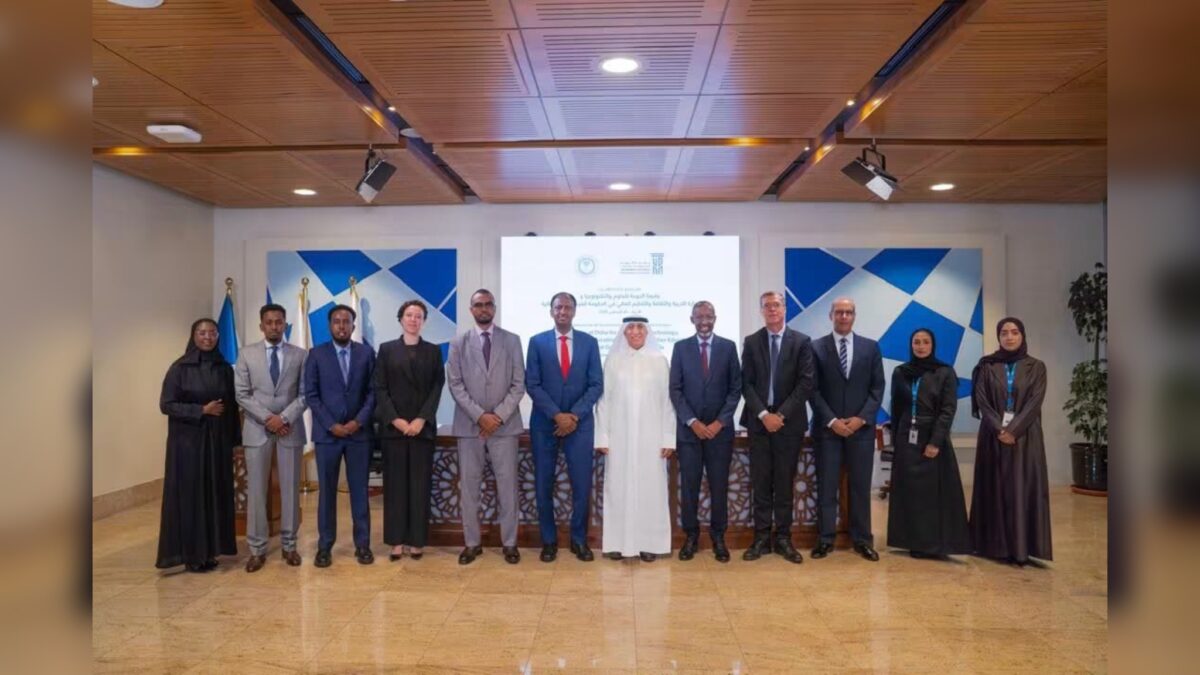
The agreement was signed in Doha between Somalia’s Ministry of Education, Culture and Higher Education and the University of Doha for Science and Technology (UDST), laying the foundation for the establishment of the Somalia Technology University (TUS University).
Under the agreement, UDST will support the new institution in curriculum development, lecturer training, academic quality assurance and certification, according to Somalia’s Ministry of Education.
The first phase is expected to cover fields including technology, marine sciences, aviation, petroleum, engineering, energy and healthcare management.
According to Somali government officials, the agreement will initially support joint academic diploma programmes in five areas: information technology, information systems, construction engineering, electric power and renewable energy engineering technology, and healthcare management.
Mohamed Abdullahi Mohamud, Somalia’s Director General of Higher Education, signed the agreement on behalf of the ministry, while Dr. Rachid Benlamri, UDST Vice President for Academics, signed for the Qatari university.
Somalia’s Minister of Education, Culture and Higher Education Farah Sheikh Abdulkadir, Somalia’s ambassador to Qatar and senior UDST officials attended the signing ceremony.
Dr. Benlamri said the partnership reflects UDST’s commitment to applied education through international cooperation and knowledge exchange.
“We look forward to sharing our academic expertise in program development, faculty professional development, and quality assurance, while working with the Ministry to create meaningful opportunities that contribute to the development of higher education in the Federal Republic of Somalia,” Benlamri said.
The partnership also includes cooperation on establishing a joint, co-branded institute in Somalia, according to the officials
The agreement comes as President Hassan Sheikh Mohamud’s government seeks to expand Somalia’s public university system.
While addressing members of Somalia’s Federal Parliament during the opening of the bicameral parliament early last month, President Hassan Sheikh Mohamud said the government would establish a second national university as part of efforts to expand access to higher education.
The move would mark a major expansion of Somalia’s national university system, which is currently centred on the Somali National University, known in Somali as Jaamacadda Ummadda Soomaaliyeed.
The Somali National University traces its origins to 1954, when the institution was established during the United Nations Trusteeship period.
It obtained official national university status in 1969.
The university later became one of the country’s main institutions for producing professionals in fields including law, economics, education, medicine, engineering, agriculture and veterinary science.
The university was forced to close after the collapse of Somalia’s central government in 1991 but was officially reopened in August 2014 as part of efforts to rebuild the country’s public education system.
The establishment of a second national university would represent a significant expansion of Somalia’s state-backed higher education infrastructure, while the technology university could provide a more specialised focus on applied science and technical disciplines.
The partnership with UDST places practical and technical education at the centre of the proposed university.
UDST is Qatar’s applied university, with programmes spanning engineering and technology, computing and information technology, business and health sciences.
Its model places strong emphasis on practical learning and preparation for employment.
The cooperation is also expected to prioritise the training and professional development of Somali lecturers who will eventually form part of the academic workforce of the new institution.
Building local teaching capacity is particularly important for Somalia, where higher education institutions continue to face shortages of qualified academic staff and limited institutional resources.
Somalia’s education reforms have increasingly focused on strengthening teaching quality and professional development.
The new university is also being developed within the framework of Somalia’s National Transformation Plan 2025–2029, which identifies human capital development, education and skills as important components of the country’s wider development agenda according to Somalia’s Ministry of Education officials
Director General Mohamed Abdullahi Mohamud described the agreement as an important step in strengthening Somalia’s higher education sector.
“This partnership with UDST is an important step in strengthening higher education in the Federal Republic of Somalia. We look forward to benefiting from UDST’s expertise in academic development and capacity building to create new opportunities for Somali students and institutions,” Mohamud said.
The Director General said by focusing on areas such as engineering, energy, information technology, construction and healthcare, the institution could help address technical skills gaps while supporting Somalia’s longer-term reconstruction and economic diversification.
The agreement also provides a framework for continued cooperation in joint programmes, faculty development, quality assurance and institutional capacity building.
If successfully implemented, the project would add a new pillar to Somalia’s public higher education system while giving the country a specialised institution focused on technology, engineering and other skills-intensive sectors.