By Hassan Adan
Dressed in a crisp white shirt and navy tie, Abdulkadir Ali Abdullahi sits comfortably in a polished wooden chair, a quiet, confident smile on his face. Behind him, shelves lined with classic books create a scholarly setting as he reflects on a journey that has taken him from SIMAD University in Mogadishu to a lecture hall thousands of miles away in Malaysia.
“I wasn’t nervous,” he said. “I felt prepared.”
That confidence would soon be tested.
After graduating from SIMAD University in November 2025 with a bachelor’s degree in Economics, Abdulkadir secured admission to pursue a master’s degree in Development Studies at the Faculty of Business and Economics at the University of Malaya.
His journey is more than the story of one Somali graduate pursuing higher education abroad. It also offers a glimpse into the changing aspirations of a generation of young Somalis who have grown up amid insecurity, limited employment opportunities and a long-standing culture of migration in search of a better future.
For many young people, completing university has not always guaranteed a stable career.
Limited formal employment opportunities have left some graduates struggling to find work commensurate with their education, while others have looked beyond Somalia in search of employment and economic security.
For years, some young Somalis turned to tahrib — irregular migration through dangerous routes across the region and towards the Gulf — hoping to find jobs and better living conditions.
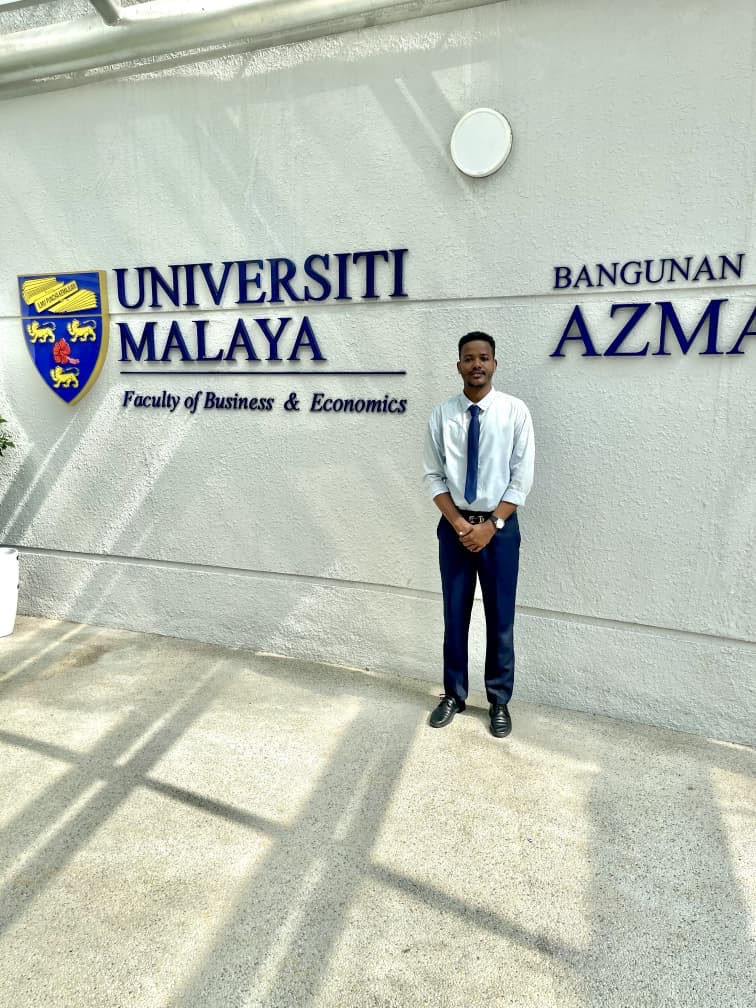
Abdikadir Ali Abdullahi poses for a picture at the main gate of the University of Malaya in Kuala Lumpur, Malaysia.
Some undertook perilous journeys across the Red Sea and other bodies of water, exposing themselves to trafficking, exploitation and, in some cases, death.
The phenomenon became particularly visible among young graduates at a time when insecurity and the weakness of the formal labour market narrowed their options.
About a decade ago, Somalia’s security environment also made public-sector employment particularly risky in areas affected by the militant group al-Shabaab, which has targeted government institutions and people associated with the state.
For young people who had invested years in university education, the contrast was stark: a degree promised knowledge and opportunity, but the path from graduation to employment remained uncertain.
Rather than leaving Somalia through an irregular migration route, Abdulkadir pursued further education through a formal academic pathway that took him from Mogadishu to Malaysia.
Before formally beginning his master’s studies, however, he was required to sit for an international English proficiency examination — a standard requirement for many universities around the world.
For many students, such examinations can be a daunting barrier. For Abdulkadir, the test became a moment of validation.
“The exam felt familiar,” he said. “The structure, the listening, the writing — it was exactly what I had trained for.”
That preparation, he says, came from his time at the Institute of Modern Languages (IML), a multilingual department within SIMAD University designed to equip students with language and communication skills.
Alongside his Economics degree, Abdulkadir enrolled in English language courses at IML, a decision he now describes as “transformational.”
“IML didn’t just teach English,” he explained. “It taught confidence — how to express ideas, how to think globally.”
This year, the Institute of Modern Languages marks 10 years of offering English language programmes at SIMAD University, a milestone that comes as Somali universities increasingly seek to prepare graduates for academic and professional opportunities beyond the country.
Mohamed Shariff Abdulle, Deputy Director of IML, said the institute’s approach is centred on giving students language skills that complement their academic qualifications.
“By offering multilingual training alongside degree programmes, IML enables students to meet the linguistic and communication demands of international education systems,” the Director said in an interview with Frontier Online Media from his third-floor office.
For Abdulkadir, the value of that preparation became clear after he arrived in Malaysia.
He said the combination of language training and academic preparation provided him with a smooth transition into the Malaysian education system, allowing him to adapt quickly and engage confidently in his studies.
“When I arrived in Malaysia, I didn’t feel like a stranger academically,” he said. “I could follow lectures, participate in discussions and complete my assignments with confidence.”
Ahmed Abdullahi, a senior lecturer at IML,SIMAD University, said language proficiency can be an important part of preparing Somali students for international academic environments.
“Language is not simply a subject that students study in the classroom. It is a tool that enables them to access knowledge, communicate their ideas and participate confidently in academic environments beyond Somalia,” Ahmed said.
He said combining language training with university education can help students overcome some of the difficulties they may encounter when transitioning into foreign academic systems.
“For a student going abroad, having strong communication skills can make the difference between simply attending an international university and fully participating in the academic experience,” Ahmed said.
Mahad Mohamud Salad, a trainer of trainers at Galmudug Teachers Training College under the Ministry of Education, said the importance of preparing students extends beyond their ability to study abroad.
“Education should prepare young people not only to earn qualifications, but also to acquire skills that they can use wherever they find themselves and, ultimately, to contribute to their communities,” Mahad said.
He said Somali students who gain international academic exposure can bring back knowledge and professional experience that may benefit institutions and communities at home.
“When young Somalis acquire quality education and international experience, they have an opportunity to transfer that knowledge when they return and use it to strengthen education, public institutions and other sectors of society,” Mahad said.
The two educators’ perspectives highlight a distinction increasingly relevant to Somali graduates: obtaining a university degree is one step, while developing the skills needed to use that degree effectively in a competitive environment is another.
Abdulkadir’s experience also reflects the changing nature of Somali higher education. Universities that once operated primarily within a domestic academic environment are increasingly connecting students with international institutions, programmes and professional networks.
Founded in 1999, SIMAD University has developed into one of Somalia’s prominent higher education institutions, with a focus on academic programmes, research and innovation.
The university’s graduates now include students pursuing further education and professional careers in different parts of the world, creating a growing connection between Somali higher education and international academic institutions.
Abdulkadir’s story is one example of that connection.
His master’s programme in Development Studies at the University of Malaya is taking him into areas that he hopes will eventually have practical relevance for Somalia, including economic development, governance, public policy and infrastructure.
“I plan to use my international education to contribute to Somalia’s development, particularly in areas such as economic development, governance, public policy, and infrastructure development,” he said. “I aim to apply the analytical and research skills I have gained to support evidence-based decision-making and contribute to sustainable development initiatives in Somalia.”
His ambitions come against the backdrop of a Somali diaspora that has increasingly contributed skills and professional expertise to institutions at home.
In recent years, Somali professionals who studied or worked abroad have returned to the country and taken positions in government institutions, universities, businesses and development organisations. Others have established businesses and initiatives that have created employment opportunities for fellow Somalis.
The return of professionals has added another dimension to the relationship between education and migration.
For some Somalis, international exposure is no longer viewed solely as a permanent departure from the country, but also as an opportunity to acquire knowledge and experience that can later be applied at home.
That possibility is central to Abdulkadir’s plans.
He does not describe his move to Malaysia as an escape from Somalia. Instead, he sees it as part of an academic journey that began in Mogadishu and that he hopes will eventually bring him back with additional knowledge and expertise.
For students aspiring to follow a similar path, Abdulkadir offers advice based on his own experience.
“My advice is to focus on continuous practice, consistency, and making use of available academic support systems such as language centers and academic workshops,” he said. “Students should not be discouraged by initial difficulties, as language and confidence improve significantly with time, effort, and active participation in learning environments.”
His journey also provides a different perspective on the choices facing Somali youth.
While some young people continue to leave the country through irregular migration routes because of economic pressures and limited opportunities, others are pursuing education, professional training and international academic opportunities through formal channels.
Back in Malaysia, Abdulkadir is focused on completing his master’s degree.
The journey that began in a classroom in Mogadishu has taken him thousands of miles away, but his ambitions remain closely connected to the country where his education began.
“I carry where I come from with pride,” he said.