By Hassan Adan
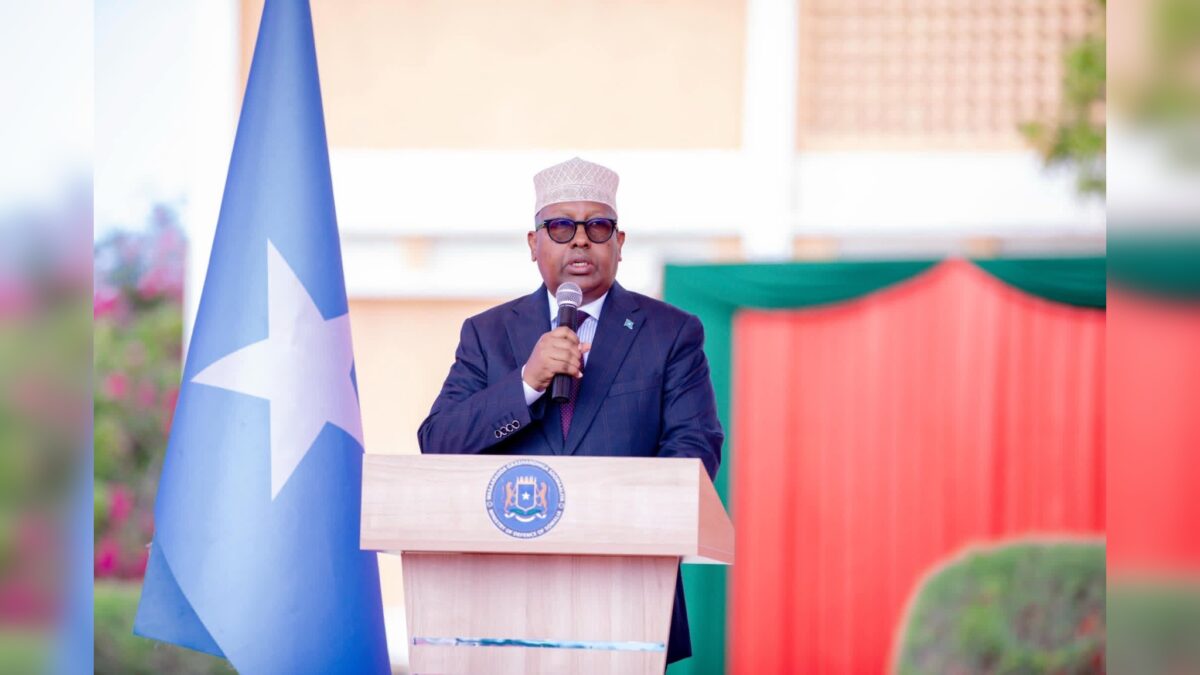
Somalia’s Defence Minister Ahmed Moalim Fiqi on Wednesday warned opposition groups against mobilising armed militias ahead of planned anti-government demonstrations in Mogadishu, saying the federal government would respond forcefully to any attempt to destabilise the country through violence.
“We are not attacking the opposition, but if they bring armed militias, we will break their hands,” Fiqi said while responding to opposition leaders who vowed to stage mass protests on June 4 over what they described as President Hassan Sheikh Mohamud’s “illegal stay in office” following the extension of his constitutional mandate.
The defence minister said the government respects peaceful political activity and the constitutional right to protest, but warned that security agencies would not tolerate armed groups operating in the capital under the cover of political demonstrations.
He accused some opposition politicians of attempting to create instability in Mogadishu at a time Somalia is intensifying military operations against the militant group Al-Shabaab.
The remarks come amid escalating political tensions following the collapse of high-level negotiations between the federal government and opposition leaders held earlier this month at the Halane compound in Mogadishu.
The talks, which brought together senior political stakeholders and members of the Somali Future Council, ended without an agreement after days of discussions over constitutional reforms and the country’s electoral process.
The opposition accuses the government of unilaterally pushing controversial constitutional amendments through parliament without broad national consensus.
The disputed changes include provisions related to Somalia’s governance structure, the powers of key state institutions and the transition toward a one-person, one-vote electoral system.
Government officials argue the reforms are necessary to complete Somalia’s long-delayed constitutional review process and move the country away from the clan-based indirect voting model that has shaped Somali politics for decades.
The administration says parliament acted within its constitutional authority when approving the amendments.
Opposition leaders and some federal member states, however, argue that the amendments were rushed through both houses of parliament without sufficient consultation with political stakeholders and regional administrations.
Critics say the reforms risk concentrating excessive power in the presidency and could deepen political divisions in the fragile Horn of Africa nation.
The constitutional dispute has emerged as one of Somalia’s most significant political crises since President Hassan Sheikh returned to office in 2022.
During the presidential election held that year before lawmakers, diplomats and international observers, several candidates pledged that if elected they would complete Somalia’s provisional constitution, arguing that finalising the constitutional framework was essential for long-term political stability.
President Hassan Sheikh’s administration later accelerated the constitutional review process, eventually securing parliamentary approval for amendments that triggered sharp criticism from opposition groups.
The opposition now argues that the extension linked to the constitutional changes lacks legitimacy, an accusation the federal government strongly rejects.
International partners have increasingly voiced concern over the growing political standoff in Mogadishu.
The African Union recently called on Somali leaders to resume dialogue after the Halane negotiations collapsed without agreement, warning that unresolved political disputes could undermine ongoing security gains against Al-Shabaab.
The United Nations, the European Union and other international partners have also repeatedly urged Somali political leaders to pursue inclusive consultations and consensus-building on constitutional and electoral matters, stressing the importance of political unity as Somalia faces security and economic challenges.
Opposition leaders insist the June 4 demonstrations will proceed as planned, describing them as peaceful protests aimed at defending constitutional order and democratic governance.
Government officials, meanwhile, say security agencies remain on high alert to prevent violence or attempts by armed groups to exploit the demonstrations for political or militant purposes, raising fears of renewed political instability in Somalia at a critical period for the country’s state-building efforts.